Stories of Students Thriving Through Creativity and Innovation
Innovating a Better Village
At the Agahozo-Shalom Youth Village (ASYV), educators encourage our students to move beyond theory to apply their classroom learning in subjects like chemistry, physics and economics towards solving real-world challenges. Recently, as part of this hands-on, project-based learning, a group of chemistry students applied their scientific know-how towards developing a new, improved hand soap. The soap is both highly effective and gentle on the skin. Today, we are using it Village-wide. Below, we chat with Nyirakaneza Princess and Niyomukiza Pascal, two fourth-year students behind the project.
What did this project teach you?
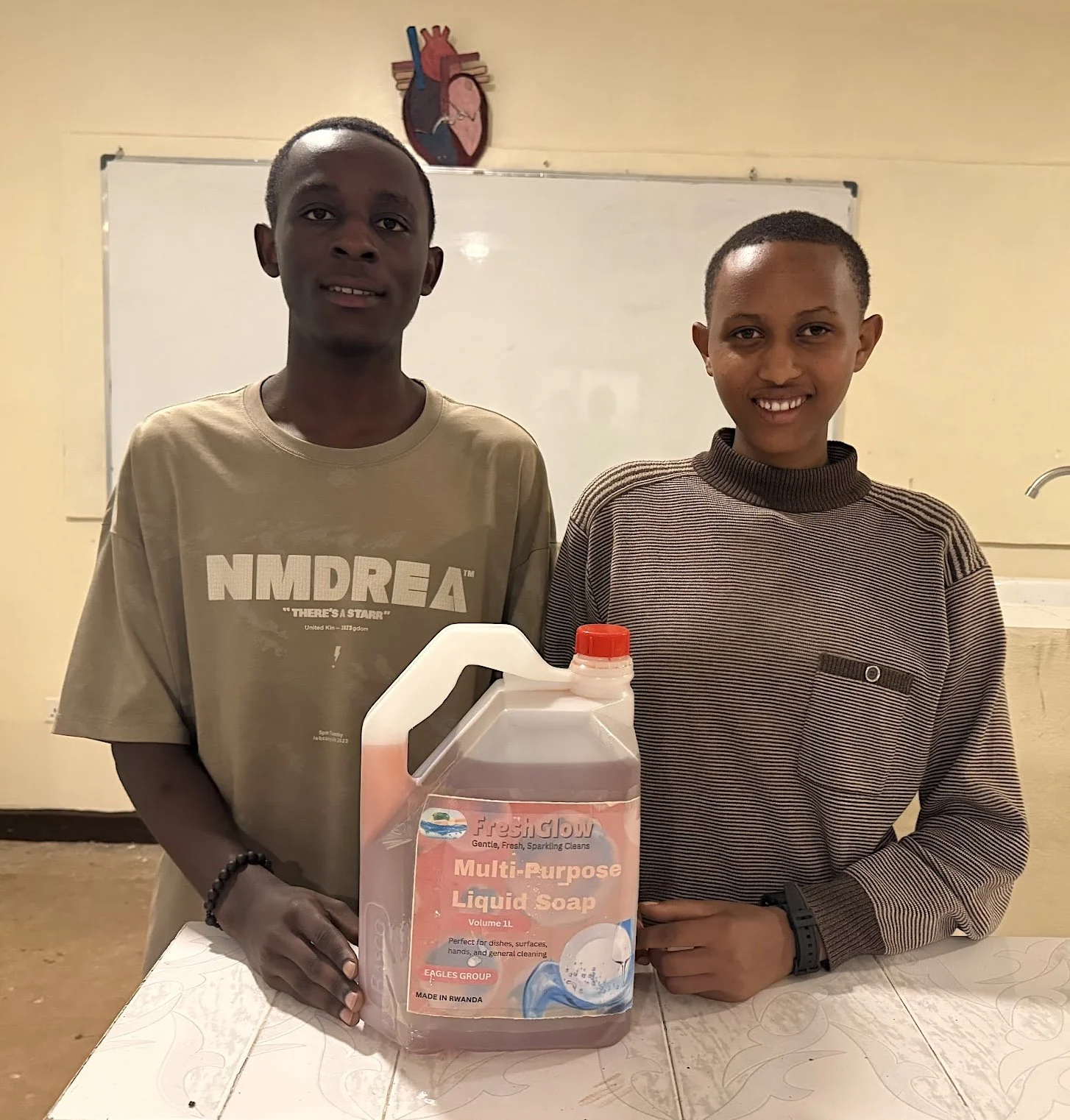
Princess (right) and Pascal pose with their new and improved soap.
Princess: The subjects we learned are not only meant to remain in a classroom or be used only for exams. We can also use them in real life. When you put theory into practice, you can make a soap that can be used by everyone. We can impact our entire community.
Pascal: It’s very powerful that chemistry can solve certain problems we face each day. We've been preventing infectious disease because people are using our soap to wash their hands.
What was most challenging about creating the detergent?
Princess: We wanted to perfect our pH. We tested the pH of other soaps to see what was best.
Pascal: Yes. We followed all the procedures, but after measuring we found at first that the soap was too acidic. So we had to adjust the acidity and level up the pH. We had to use a base. We use sodium carbonate. And we've been creating labels so that we name our soap and include information on the content and ingredients.
When did you become interested in science?
Pascal: Before ASYV, science was purely academic to me. I would read the words and a teacher would teach things in a classroom, but I wouldn't see the impact. Coming here to ASYV, it is like something shifted. I began working in the Science Center, where I can make interesting projects for myself. Now, I understand the real meaning of science.
Princess: Before coming here, I was still interested in science. But I was thinking of science and being a scientist as just getting good grades in a class. But after getting here, I learned that science is beyond the classroom. I learned how science can be used to improve the quality of life of the people around you.
What advice do you give your younger ASYV siblings who want to pursue science?
Pascal: I say to them that it is important to use the resources at ASYV and see how science can be used in the world around you. The teachers in the science department will provide a lot of guidance.
Princess: I agree. I tell them to learn as much as they can and study as much as they can, so they can take those skills to make an impact in the world.
My First Months at ASYV
In Bwira News, our student blog, Ntihebuwayo Nehemie, a third-year student and member of ASYV’s Media Club, discusses his video featuring three first-year students.
I made this video because when a student arrives here at Agahozo-Shalom, they don’t know much about the Village. I wanted to show these students a few months into their time here—to capture the moment when they first understand all that we have here at ASYV, and how they can use those resources to improve their lives.
Take me: I had never seen, or touched, a camera before I came here. Right away, I thought to myself that I have to go into cinematography. Read more in Bwira News.
Refugee Students Creating Thriving Futures Through IRIS
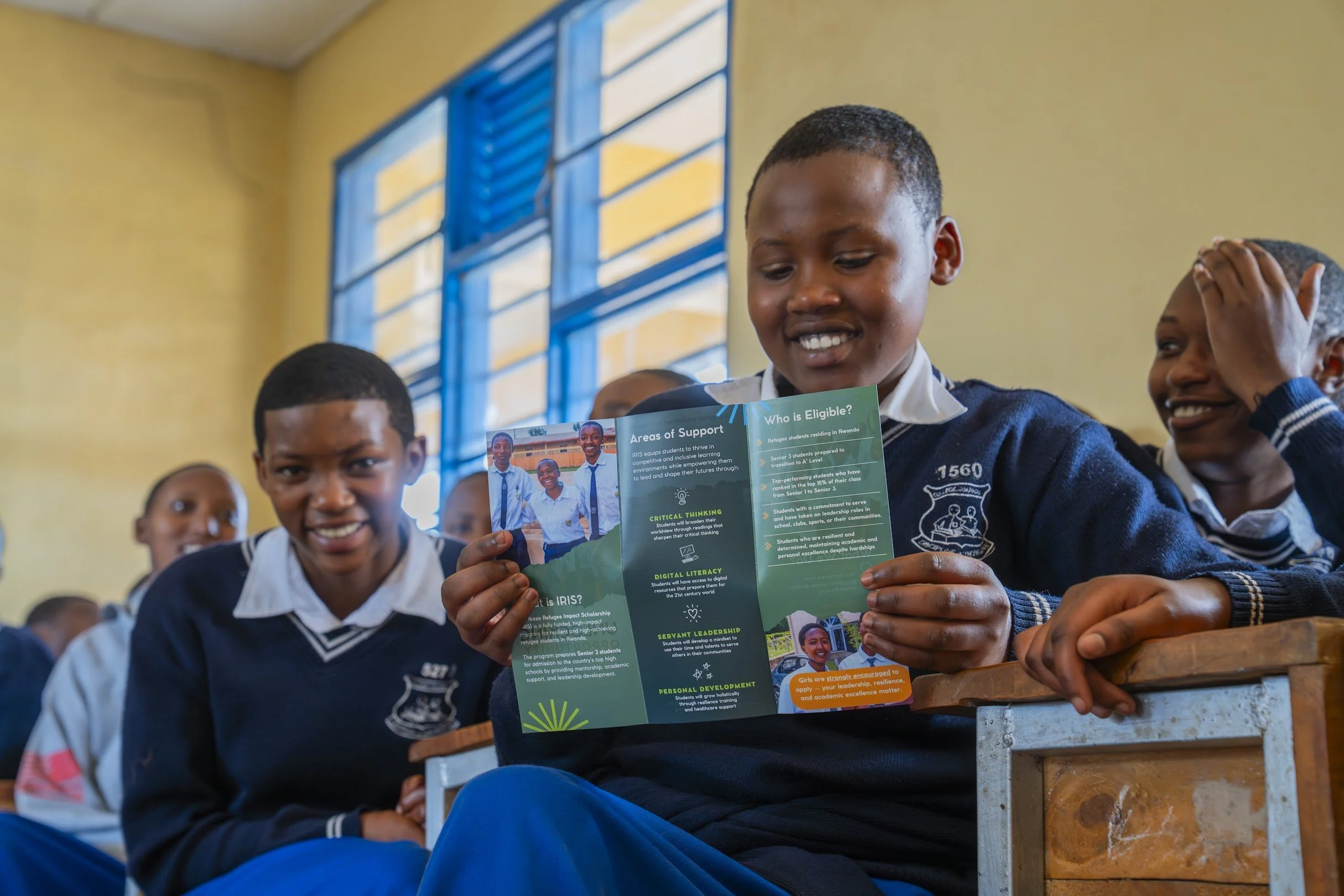
Through IRIS, refugee students across Rwanda access the resources the need to thrive in school.
Today, over 50,000 school-aged refugees live in Rwanda, and many struggle to access the quality education and resources they need to achieve their dreams. In recent weeks, the team behind our Ikaze Refugee Impact Scholarship (IRIS) program has been busy conducting awareness campaigns in all five of Rwanda’s refugee camps. The goal: encourage more girls to apply to join this year’s class of IRIS scholars.
Run in partnership with the Rwandan education organization Isomo and the Shapiro Foundation, IRIS provides high-performing refugee students with the academic, mental health, and financial support they need to thrive in top secondary schools across Rwanda. Before enrolling in their new schools, IRIS scholars attend an orientation camp here in the Village. Below, four current IRIS scholars talk about how the program is impacting them.
“I am from Burundi, and have lived in Mahama refugee camp since I was a little child. At the school I went to in the camp, there were no books except the one for teachers. With IRIS, I see more for my future. At ASYV, I saw counselors. Now, I want to do that job. I want to study hard and become a psychotherapist. I want to help children who have trauma from war like me and give them hope.”
“In the refugee camp, I did not hope to go to university. I had never used a laptop before, but at ASYV, they taught me. I met many friends from other camps there, and we bonded like brothers and sisters. The staff talked to us about our feelings. Now, I feel I am not alone. I am more confident. I want to attend university and be a teacher. I want to change life for my family and for my country.”
“I am from Burundi. I have been in the Mahama camp for almost all my life. In the camp, I learned things, but we had no computer, no library. At ASYV, I met kids from Congo and Burundi, and we shared our stories. I learned that I am not alone. Now, I speak more and join others, even here at my new school. I think IRIS will make my future bright. I have hopes to become someone important, maybe a teacher or nurse.”
“At ASYV, I learned to be responsible and think bigger. I feel I can become whoever I want, and use my education to help others and the environment. Maybe I will start a project to clean water or improve farming. If many students in the camps can be part of IRIS, we will have more leaders. We can change the mentality, show others refugees can contribute and benefit both our community and Rwanda.”